
Your CRM is NOT a Chore
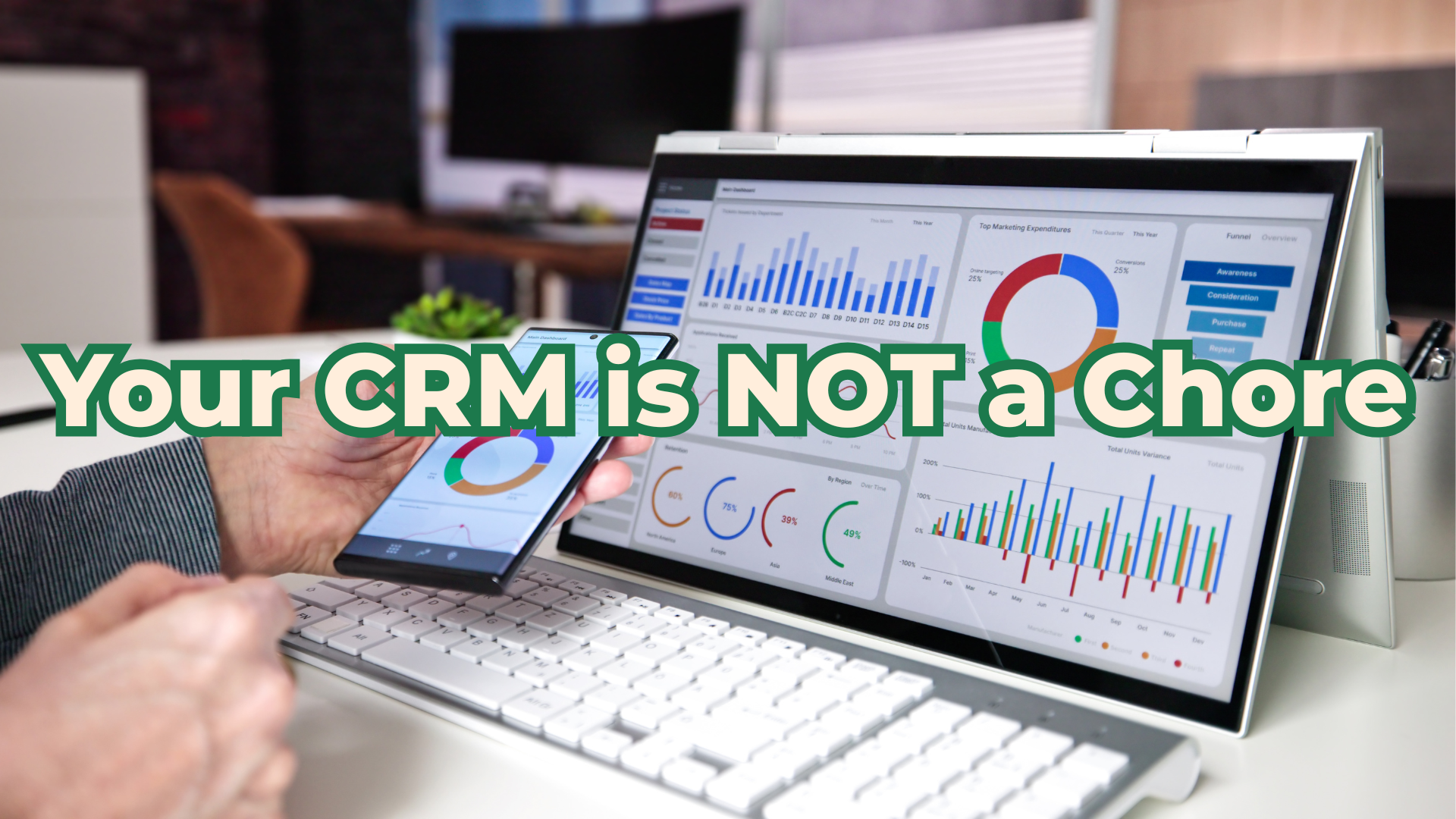
Your organization’s CRM stands for Customer Relationship Manager. But those words only ring true if you use your CRM fully and well as the powerful productivity tool it was designed to be. Because if you instead mistreat it as a dull task—and cheat yourself in the process—of course you’d be prone to thinking of your CRM as Can’t Remember Much.
What an expensive mistake!
The considerable value of your CRM is defined by what you put into it in a consistent, timely, purposeful way. When used properly, it aligns what’s done daily in sales with where you and your team must go strategically in the longer-term. It provides powerful tools: accurate, relevant information about your daily performance as a seller, and actionable opportunities for you and your coach so that you can diagnose and solve issues arising from your sales process.
Unpacking those features reveals must-do steps to unlock its benefits so you can achieve CRM mastery. Let’s look at each one now…
ACCURACY DEPENDS ON HABIT
Be honest. Are you entering your CRM data in real time, every day? The only way you can generate accurate sales data—and produce insights from it—is by entering it as it happens daily…otherwise you’re creating a distorted picture of your daily results. A habit-powered dashboard gets populated with fresh, real-time metrics seen over and over. And what gets seen gets improved. Same goes for your CRM’s dashboard reports. Everything you enter as you learn about it—training webinar links, ROI calculators, marketing scripts, leads lists—gives you and other sales reps what’s needed to execute confidently and correctly on every opportunity and every closing. All success starts from habits: there are no shortcuts.
ACTIONABILITY DEPENDS ON INSIGHTS
It’s no surprise to me that top sales performers are the best CRM users: they work from it, not into it. It means that instead of mistreating it as an administrative burden, they use their CRM skillfully as their mission control: telling them daily which items and which opportunities need action. The only way to properly determine those next steps is by having insights produced by accurate data inputted habitually (as I discussed above). A sales rep has to be able to trust the insights that their CRM gives them, otherwise it understandably gets ignored.
RELEVANCE DEPENDS ON PURPOSEFUL SELECTION
A CRM power user thrives on relevant sales information, procured through a process of purposeful selection. They know how to mine their CRM for what I call Sales Velocity data. That concept is covered in detail in my book, Right on the Money. In essence, it tracks four things: the total number of opportunities in your pipeline, average deal size, your closing rate and your sales-cycle speed. Your CRM helps you translate these critical inputs into knowledge, which you apply in your sales process to know if you are trending behind or ahead of plan—as well as the knowledge to know which metrics need to be improved.
QUALITY PERFORMANCE DEPENDS ON QUALITY RECORDING
A Sales VP I’ve worked with at a Fortune 500 company says this: “You don’t get good data without coaching, and you can’t coach without good data.” When you are coaching sales performance, the right way to think about the data in that exercise is as though you’re recording an athlete on the field on game day. That’s the only way to get an unblemished picture of what’s really going on. Here, the wins are less important than the mistakes. Study every missed shot. Every overlooked opportunity. Every failure to close. Sure, no one likes to see their biggest mistakes on replay. But unlike success, which consists mostly of lagging indicators, failure is instantly knowable and coachable to produce better outcomes next time. This can only happen consistently if your CRM is running properly with accurate, reliable and insightful information.
SOLVING PROBLEMS DEPENDS ON CORRECTLY DEFINING THEM FIRST
Do you have an opening problem or a closing problem? A lead management problem? What about a sales forecasting problem? A well managed CRM knows the answer, but a poorly managed one simply can’t. Properly defining a problem hinges on having reliable data from which understanding and insights can grow. Even after you’ve correctly zeroed-in on a sales problem, fully solving it also requires insight. This is where a lot of sellers fall short. You must use your problem-solving CRM data to compare where you are to where you need to be to hit your longer-term goals. Metrics are pointless unless they serve a strategic outcome focused on improving your performance.
HERE’S WHAT YOUR CRM REALLY IS FOR…
Yes, your CRM is a power tool. It doesn’t exist to be a daily burden. Nor is it there to make you look good. It’s there to teach you something: to give you and your coach an accountability framework and meaningful insights you can work on together to make you the best at what you do.
You’ve two choices with a CRM. Either cheat at the data and guess at what to do next every day. Or recognize its true potential and give it reliable, timely data to do its job well. As I explain in my book: “Numbers yield facts and create deeper understanding.” That’s how you correctly apply all of its powerful features and reap the incredible benefits of this technology.